Showing posts with label Frequently Asked Questions. Show all posts

Friday, November 1, 2024

How to Remove Your License Isn't Genuine Notification in Microsoft Office 2016, 2019, 2021

Some Office 2016, 2019, 2021. Users experience a new yellow-colored warning stating "Get Genuine Office you may be a victim of software counterfeiting. Avoid security risks and get genuine office now"

ACTION NEEDED Your license isn't genuine
Remove Get Genuine Office Warning in 6 Simple Clicks

The message may also appear in Office 2016, 2019, 2021. Even if you have paid for the Office license, and you believe your license is Genuine, you may see this text bar appear.  Apparently, in Microsoft’s opinion, your license is not 100% valid. Reasons are:
  • You have installed and validated Office on more than 1 computer with the same license. Office licenses may only be used on 1 pc
  • You have bought the license from a questionable reseller. Some websites sell Office licenses for approx. 10 dollar. That is almost certainly different than the normal price for an official license
  • Your license key may have been leaked and is being used by others. In this case, please contact Microsoft.
Remove Get Genuine Office Warning in 6 Simple Clicks
Genuine or not, luckily it’s easy to get rid of the warning. Follow these steps to turn off the Get Genuine Office notification:
Total Time: 1 minute

Windows > Microsoft > Program Files (x86) > Microsoft Office > Office16
C:\Program Files (x86)\Microsoft Office\Office16
Right Click 
OSPPREARM.EXE
Run as Administrator
DONE


If you have any questions or concerns. Please feel free to contact us any time through this website or through this E-mail: Sales@TTLCompany.com | Web:http://TTLCompany.com

Friday, October 25, 2024

What is Kidde Fluoro-K? Is Fluoro-K the same as Novec?

What is Kidde Fluoro-K?
EXTINGUISHING AGENT
Fluoro-K™ Fire Suppression Clean Agent (herein referred to as “agent”) is a fluorinated ketone (Dodecafluoro-2-methylpentan- 3-one) compound of carbon, fluorine and oxygen (CF3CF2C(O)CF(CF3)2). It is colorless, electrically non-conduc- tive and has a low odor. 

Kidde Fire Systems Fluoro-K™ based clean agent fire suppression systems are safe, competitive, and costeffective fire suppression solutions for protecting assets in commercial, light, and heavy industrial applications.
The Fluoro-K agent itself is colorless, with low odor and no particulate or oily residue allowing for minimal business disruption after a discharge. From an environmental standpoint, Fluoro-K has zero ozone depletion potential, and an atmospheric lifetime of less than five days. 

Is Fluoro K the same as Novec?
Fluoro-K is a FK-5-1-12 chemical clean agent alternative to Novec 1230 (which will eventually be phased out), and which addresses the same purity and toxicity concerns associated with Halon. In most cases, a system originally designed for Novec requires no hardware changes if converted to using Fluoro-K.

What is the difference between Novec 1230 and fk-5-1-12?
What's the difference between Novec 1230 and FK-5-1-12? Simply put, Novec 1230 is a trade name or chemical name for the product manufactured by 3M. When the chemical is manufactured elsewhere, it meets the same specification and is governed by the same rules and regs. FK-5-1-12's chemical composition does not change.

✔ Product Documentation Links: [Datasheet - Tech Specs] [ECS-500 Fluoro-K]

If you have any questions or concerns. Please feel free to contact us any time through this web site or through this E-mail: Sales@TTLCompany.com | Web: http://TTLCompany.com

Friday, July 5, 2024

Tại sao Novec 1230 bị ngừng sản xuất?

Bạn có nên lo lắng về tương lai của Novec 1230 không?
Như chúng ta đã biết 3M đã thông báo vào tháng 12 năm 2022 rằng họ sẽ ngừng sản xuất Novec 1230 vào cuối năm 2025 như một phần trong quyết định kinh doanh ngừng sản xuất các chất có liên quan đến thành phần Polyfluoroalkyl (PFAS) đến toàn công chúng tại Hoa Kỳ & Thông tin được cung cấp ở đây nhằm giải thích một số thông tin cơ bản quan trọng cần thiết để hiểu chi tiết về các hành động cụ thể mà EPA (U.S. Environmental Protection Agency) thực hiện để giải quyết PFAS và các sự kiện mới nổi khác liên quan đến PFAS.

PFAS còn tạm gọi là "Hóa Chất Vĩnh Cửu" là các hóa chất nhân tạo được sử dụng trong rất nhiều sản phẩm gia dụng và công nghiệp. PFAS có thể tồn tại trong môi trường 10 năm đến 1000 năm mà không bị phân hủy hay biến mất. Tác hại của hóa chất vĩnh cửu đến sức khỏe con người là vô cùng lớn; Vì chúng không phân hủy một cách tự nhiên và có thể tích tụ trong đất, nước và cơ thể con người. Chúng tích tụ trong môi trường và trong máu, trong mô, trong xương của con người gây hại cho gan, phổi và về lâu dài có thể gây bệnh ung thư, tác động xấu tới tuyến giáp, có thể khiến trẻ nhỏ bị thấp còi. Chúng có hại cho quá trình trao đổi chất và tiêu thụ calo, gây rối loạn nội tiết tố và tác động tới hệ nội tiết, làm giảm số lượng tinh trùng, thậm chí có thể làm suy giảm miễn dịch. 
Do vậy, 3M đã trích dẫn một số lý do cho quyết định này, bao gồm:

+ Xu hướng: Gia tăng các quy định nhằm giảm hoặc loại bỏ PFAS trong môi trường
+ Cung & Cầu: 3M Novec 1230 trong suốt năm 2022-2024 sẽ đối mặt nguy cơ thiếu hụt
+ Tồn kho: 3M không dự kiến ​​sẽ dự trữ sản phẩm này đến hết 2024. 

Trong khi NOVEC 1230 được phân loại là chất Polyfluoroalkyl (PFAS), chất này hiện tại là an toàn theo PFAS khi sản xuất và sử dụng đồng thời có ít hoặc không có khả năng làm nóng lên toàn cầu, những thay đổi trong quy định liên bang (chẳng hạn như Đạo luật AIM) đã khiến 3M mệt mỏi trong việc tiếp tục sản xuất... 
Khi ngành phòng cháy chữa cháy trải qua giai đoạn chuyển đổi, chúng ta buộc phải tạm biệt NOVEC 1230, một chất làm sạch hydrocarbon (HC) đã phục vụ tốt cho chúng ta trong nhiều năm. Mặc dù cụm từ “tạm biệt” có vẻ gợi nhớ đến một lời chia tay buồn bã, nhưng điều quan trọng cần phải nhận ra là sự thay đổi này không có nghĩa là ngoài kia không có những dung môi hóa chất PCCC tác nhân sạch tương đương. Đồng nghĩa khi đóng một chương, Chúng ta sẽ mở một chương khác, không có gì mạo hiểm cả mà bước vào lĩnh vực của các giải pháp mới, loại dung môi mới ngăn chặn & PCCC để thay thế phù hợp với các quy định về môi trường hơn.

Chất thay thế cho Novec 1230 là gì?
3 lựa chọn thay thế hàng đầu cho 3M Novec là Fluorinated Ketones (FK-5-1-12), Hydrofluoroolefin và Hydrofluoroether. Những chất lỏng này có các đặc tính tương tự như Novec 1230, chẳng hạn như độc tính rất thấp và Zero, độ ổn định nhiệt cao và không bắt lửa, đồng thời thân thiện với môi trường hơn.

Điều gì sẽ thay thế Novec 1230?
Novec 1230 là chất làm sạch được ưa chuộng để chữa cháy vì nó hiệu quả mà không gây hư hại thiết bị do nước hoặc để lại dư lượng có hại. Tuy nhiên, một số người nói rằng việc ngừng sản xuất sẽ là một trở ngại lớn cho ngành khi họ đang tìm kiếm một tác nhân sạch mới, hiệu quả và dễ sử dụng. Fluoro-K chính là giải pháp thay thế Novec 1230. Chúng ta đã có hệ thống phòng cháy chữa cháy sản xuất tại Hoa Kỳ và dung môi mới dưới tên thương mại gọi là Fluoro-K (FK-5-1-12) ngưng tụ tác nhân sạch và thân thiện môi trường dựa trên nền tảng công thức hóa học của Novec 1230 để thay thế cho Novec 1230 hoàn toàn tương tự, nhưng nó lại không bị ràng buộc bởi các quy định do EPA chẳng hạn như Đạo luật AIM. 

Joseph Ho
Florida, 4th July 2024
If you have any questions or concerns. Please feel free to contact us any time through this website or through this E-mail: Sales@TTLCompany.com | Web:http://TTLCompany.com

Wednesday, April 3, 2024

What is the difference between Fluoro-K vs. Novec 1230?

Perfluoro(2-methyl-3-pentanone) is a fluorinated ketone with the structural formula CF3CF2C(=O)CF(CF3)2, a fully-fluorinated analog of ethyl isopropyl ketone. It is used as an electronics coolant liquid and fire protection fluid sold commercially by 3M under brand names such as Novec 1230, Novec 649, and FK-5-1-12. It is also known as “waterless water” or “dry water”.

What is the difference between Fluoro-K (FK-5-1-12) and Novec 1230?

FK-5-1-12 vs. Novec 1230: Are They the Same? 
In regards to whether FK-5-1-12 vs Novec 1230 are the same extinguishing fluid, in short, they are the same. Although there is some confusion about branding, Novec 1230 is just the trade name of the extinguishing agent, FK-5-1-12.

This means that together, they’re both clean-agent fire suppression fluids looking to protect facilities all over the world with their unique extinguishing processes. As we noted above, a clean agent fluid works by reducing the oxygen level of the fire while leaving no lasting damage to all of your sensitive equipment or building properties in the aftermath.

When the automatic detection system is triggered by the heat of the flames, the Novec 1230 fire protection fluid (also known as FK-5-1-12) in the fire suppression system is designed to quickly discharge and reach the right amount needed to put out the fire within 10 seconds. This is much faster than inert gases, which usually take 60 to 120 seconds to even get close to the job of 3M Novec 1230 fluid.

What is the other name for Novec 1230?
Novec 1230 Fire Protection Fluid is based on a proprietary chemical from 3M called a fluroroketone. The full chemical name for this compound is dodecafluoro-2-methylpentan-3-one. Its ASHRAE nomenclature – the way it is designated in the NFPA and ISO 14520 clean agent standards is FK-5-1-12 (Fluoro-K)

Benefits of Novec 1230 (Fluid FK 5-1-12) Clean Agents:
Each design for your fire suppression system will be unique, but the performance of the clean agent fire suppression fluid will be the same regardless of whether it is installed correctly and within the vicinity of potential fire hazards. Here are some of the benefits of FK 5-1-12 that you will notice if you’re ever in danger of a fire outbreak:

1)-Extremely Low Environmental Impact
As you search the market for other fire suppression methods, it is clear that clean agent systems win in terms of leaving no environmental damage. They have low ozone depletion potential (ODP) and low global warming potential (GWP), helping keep our planet clean from any harmful chemicals.

2)-Quick Response Discharge
As stated above, Novec 1230 (FK 5-1-12) only needs 10 seconds to reach and suppress the fire if installed in the optimal place within your building. This fluid could be the difference between someone’s life being saved or not, so enforcing it may be something you want to consider.

3)-Flexible Applications
Although certain fire suppression systems can only be useful within certain applications, this fluid is extremely versatile in the areas where it can be efficient, such as server room fires, kitchen fires, museums, control rooms, etc.

4)-Safe For People
When discharged, some gaseous or chemical-based fluids can be extremely harmful for human consumption, whether that be suffocation or long-term health risks. However, with this clean agent, they are non-toxic and have a low atmospheric lifetime—meaning that they have no effects on your health and won’t be in the air for long anyway.

5)-Precise Suppression
Clean agent fire suppression systems are known for having excellent suppression rates, maximum coverage, and no aftermath cleanup; thus, your business won’t be out of action for long at all. 
If you want to receive all the benefits that a clean agent fire suppression system brings to the table, reach out to our qualified experts today to see if you’re the right fit for immediate installation—contact us today!


Here are some differences between Fluoro-K and Novec 1230:
+ Class C MDC value: Fluoro-K has a Class C MDC value of 4.52%, while Novec 1230 has a value of 4.50%.
+ Environmental impact: Fluoro-K is a safer agent for groundwater than Novec 1230. Novec 1230 has a global warming potential of 1, while FM200 has a global warming potential of around 3500.
+ Discharge time: FK 5-1-12 can reach and suppress a fire in 10 seconds. 
+ Both Novec 1230 and Fluoro-K are electrically non-conductive and leave no residue. They are commonly used in areas like data centers, IT rooms, museums, archives, libraries, healthcare facilities, laboratories, military applications, and marine applications.

If you have any questions or concerns. Please feel free to contact us any time through this web site or through this E-mail: Sales@TTLCompany.com | Web: http://TTLCompany.com

Tuesday, April 6, 2021

What is the differences between Novec 1230 and all of the other clean agents, including FM-200?

FM-200 (HFC-227ea) and Novec 1230 are fire extinguishing agents characterized by zero ODP and whose use in fire suppression applications results in a negligible contribution to climate change (global warming). 

There are three major differences between Novec 1230 and all of the other clean agents, including FM-200: 

a/- CHEMICAL REACTIVITY. Unlike the HFC and inert gas clean agents, which are characterized by very low chemical reactivity, Novec 1230 is characterized by high chemical reactivity. 

The HFC and inert gas clean agents are all unreactive with water, alcohols, amines, and solvents. Novec 1230, on the other hand, is characterized by high chemical reactivity. For example, Novec 1230 design manuals indicate the following: (1) Contact of Novec 1230 with water or solvents either polar or hydrocarbon could render Novec 1230 fluid ineffective, (2) the transfer of Novec 1230 requires the use of a drier because humid air may cause the agent to convert to acid. It is reported that Novec 1230 is chemically reactive with nucleophiles such as alcohols. Novec 1230 is also chemically reactive with other fire extinguishing agents, e.g., it has been reported that Novec 1230 undergoes reaction with sodium bicarbonate. The reaction of Novec 1230 with water produces HFC-227ea and Perfluoropropionic acid, a strong, corrosive organic acid. Due to its high reactivity, Novec 1230 is the only clean agent that is classified as a volatile organic compound (VOC). 

b/- INTERACTION IN THE BODY. Unlike the HFC and inert gas agents, Novec 1230 undergoes reaction in the lungs. Novec 1230 reacts to form HFC-227ea and Perfluoropropionic acid when it crosses the lung-air interface. In contrast, FM-200 does not react to form potentially hazardous products; the toxicity of FM-200 is so low that it is approved for use as a propellant in metered dose inhalers (MDIs), where it is employed to propel a medicament down the throat of the patient into his/her lungs. 

c/- PHYSICAL STATE. Unlike the HFC and inert gas clean agents, which are all gaseous at room temperature, Novec 1230 is a high boiling liquid (bp = 48 C). This increases the possibility of a liquid discharge with Novec 1230 compared to the other clean agents and also affects its performance. For example, recent studies within the aviation industry have indicated that Novec 1230 is ineffective in several civil aviation applications. 

Monday, February 23, 2015

Start | Run Commands for Windows XP, Vista and Windows 7

Accessibility Controls access.cpl
Accessibility Options control access.cpl
Adapter Troubleshooter (Vista/Win7) AdapterTroubleshooter
Add Hardware Wizard hdwwiz.cpl
Add/Remove Programs appwiz.cpl
Add/Remove Programs (Add New Programs) control appwiz.cpl,,1
Add/Remove Programs (Add Remove Windows Components) control appwiz.cpl,,2
Add/Remove Programs (Set Program Access & Defaults ) control appwiz.cpl,,3
Administrative Tools control admintools
Advanced User Accounts Control Panel (Vista/Win7) Netplwiz
Automatic Updates wuaucpl.cpl
Authorization Manager (Vista/Win7) azman.msc
Backup Status and Utility (Vista/Win7) sdclt
Bluetooth Transfer Wizard fsquirt
Calculator calc
Certificate Manager certmgr.msc
Character Map charmap
Check Disk Utility (XP) chkdsk
Clipboard Viewer clipbrd
Color Management colorcpl
Command Prompt cmd
Component Services dcomcnfg
Computer Management (XP) compmgmt.msc
Computer Management (Vista/Win7) CompMgmtLauncher
Control Panel control
Credential (passwords) Backup and Restore Wizard (Vista/Win7) credwiz
Date and Time Properties timedate.cpl
Device Manager devmgmt.msc
Direct X Control Panel* directx.cpl
Direct X Troubleshooter dxdiag
Disk Cleanup Utility cleanmgr
Disk Defragmenter (XP) dfrg.msc
Disk Defragmenter (Vista) dfrgui
Disk Defragmenter defrag
Disk Management diskmgmt.msc
Disk Partition Manager diskpart
Display Properties control desktop
Display Properties desk.cpl
Display Properties (Appearance) control color
Dr. Watson System Troubleshooting Utility drwtsn32
Driver Verifier Utility verifier
Driver Package Installer (Vista/Win7) dpinst
DVD Player dvdplay
Event Viewer eventvwr.msc
File Signature Verification Tool sigverif
Files and Settings Transfer Tool migwiz
Findfast findfast.cpl
Firewall Control Panel (Vista/Win7) FirewallControlPanel
Firewall Settings (Vista/Win7) FirewallSettings
Folders Properties control folders
Fonts control fonts
Fonts Folder fonts
Game Controllers joy.cpl
Group Policy Editor (XP Prof) gpedit.msc
IExpress - Turn a cmd/vbs script into an installer .exe file C:\Windows\System32\iexpress.exe (example)
Indexing Service ciadv.msc
Internet Properties inetcpl.cpl
IP Configuration ipconfig
iSCSI Initiator (Vista/Win7) iscsicpl
Keyboard Properties control keyboard
Language Pack Installer (Vista/Win7) lpksetup
Local Security Policy secpol.msc
Local Users and Groups (XP) lusrmgr.msc
Log out logoff
Microsoft Access* msaccess
Microsoft Excel* excel
Microsoft Malicious Software Removal Tool mrt
Microsoft Paint mspaint
Microsoft Powerpoint* powerpnt
Microsoft Support Diagnostic Tool (Vista/Win7) msdt
Microsoft Word* winword
Mouse Properties control mouse
Mouse Properties main.cpl
MSN Messenger* msnmsgr
Network Connections control netconnections
Network Connections ncpa.cpl
Network Setup Wizard netsetup.cpl
Notepad notepad
ODBC Data Source Administrator odbccp32.cpl32-bit ODBC driver under 64-bit platform = C:\windows\sysWOW64\odbcad32.exe
64 bit ODBC driver under 64-bit platform = C:\windows\system32\odbcad32.exe
On Screen Keyboard osk
Paint pbrush
Password Properties password.cpl
Performance Monitor perfmon.msc
Phone and Modem Options telephon.cpl
Phone Dialer dialer
Power Configuration powercfg.cpl
Printers and Faxes control printers
Printers Folder printers
Private Character Editor eudcedit
Quicktime* QuickTime.cpl
Quicktime Player* quicktimeplayer
Regional Settings intl.cpl
Registry Editor regedit
Registry Editor regedit32
Reliability and Performance Monitor perfmon.msc
Remote Assistance(Vista/Win7) msra
Remote Desktop mstsc
Removable Storage ntmsmgr.msc
Removable Storage Operator Requests ntmsoprq.msc
Resultant Set of Policy (XP Prof) rsop.msc
Scanners and Cameras sticpl.cpl
Scheduled Tasks control schedtasks
Security Center wscui.cpl
Services services.msc
Shared Creation Wizard shrpubw
Shared Folders fsmgmt.msc
Shut Down Windows shutdown
Software Licensing/Activation (Vista/Win7) slui
Sounds and Audio mmsys.cpl
Sound Recorder (Vista/Win7) soundrecorder
Sound Volume (Vista/Win7) sndvol
SQL Client Configuration cliconfg
Sync Center mobsync
Syncronization Tool mobsync
System Configuration Editor sysedit
System Configuration Utility msconfig
System File Checker Utility (Scan/Purge) sfc
System Information msinfo32
System Properties sysdm.cplSystem Properties (Vista/Win7) SystemPropertiesAdvanced, SystemPropertiesComputerName,
SystemPropertiesDataExecutionPrevention,SystemPropertiesHardware,
SystemPropertiesPerformance,SystemPropertiesProtection, SystemPropertiesRemote
Task Manager taskmgr
Telnet Client telnet
Trusted Platform Module Initialization Wizard (Vista/Win7) TpmInit
Tweak UI* tweakui
User Account Management nusrmgr.cpl
User Accounts (Autologon) control userpasswords2
Utility Manager utilman
Windows Error Reports wercon
Windows Features (Vista/Win7) optionalfeatures
Windows Firewall firewall.cpl
Windows Firewall with Advanced Security (Vista/Win7) wf.msc
Windows Image Acquisition (scanner)(Vista/Win7) wiaacmgr
Windows Magnifier magnify
Windows Management Infrastructure wmimgmt.msc
Windows Mobility Center (Mobile PCs only)(Vista/Win7) mblctr
Windows Security Center wscui.cpl
Windows System Security Tool syskey
Windows Update wupdmgr
Windows Update (Vista/Win7) wuapp
Windows Update Standalone Installer(Vista/Win7) wusa
Windows XP Tour Wizard tourstart
Windows Version (About Windows) winver
Wordpad write

* = optional component that may not be installed on all machines.

Monday, May 12, 2014

Clean Agents FAQ

What is special hazards fire protection?
Special hazards are defined by the critical nature of an operation or how easily the protected items or functions can be replaced. To determine if you need a special hazards fire suppression system, start by asking these questions. Can the items be replaced? Can you afford down time caused by fire damage or clean-up? Are there redundant systems? Can you still operate if this system goes down?"
If you answer no to these questions, then you need to look at fire protection not only for the structure of the building, but for the assets it contains. That is special hazards fire protection.
The special hazards family consists of five types of suppression systems. They include clean agent, foam, dry chemical, carbon dioxide and water mist systems.

What are clean agents?
Clean agents are gaseous fire suppressing agents. Because they suppress fire as gases, there is no damage to protected areas from the discharge and no residue to clean up. Thus, the term "clean" agents.

I heard these agents have been banned or are about to be banned from use. Is this true?
No. Starting in the 1960s, Halon 1301 was the principal agent used in clean agent extinguishing systems. However, Halon was found to have a high ozone depletion potential, so manufacture of Halon was banned in 1994. There is no ban on the use of Halon, however, and many Halon systems are still in service.
There are also no plans to ban Halon use at any time in the future. However, the EPA strongly recommends using one of the recently developed Halon alternatives. There are three commercially available Halon alternatives that are very effective at suppressing fire.

How do I know these new clean agents are safe?
The EPA phased out Halon production as part of the Clean Air Act of 1990. Another part of that Act was the Significant New Alternatives Policy (SNAP). Under SNAP, the EPA evaluated substitute chemicals and alternative technologies to ensure that they wouldn't cause greater damage to human health or the environment that the potential ozone depleters that were being replaced. Each of today's clean agents is SNAP approved.

Can people be exposed to clean agents?
Yes, part of the SNAP approval process includes testing for adverse effects in humans at recommended design concentrations. Each of today's clean agents is safe for humans and safe for the environment as well.
Halon 1301 is also safe for occupied areas at recommended design concentrations. However, some people consider carbon dioxide a clean agent as well because it shares the non-corrosive, no clean-up features. While carbon dioxide is a very effective fire suppressing agent, it is not safe for use in occupied areas.

What are the new clean agents?
At this time, the three commercially-available clean agents for total flooding applications are INERGEN, manufactured by Ansul, FM-200, manufactured by Great Lakes Chemical Company, and FE-13, manufactured by Dupont.

Which of the new clean agents is best?
Each of today's clean agents is SNAP-approved and very effective at suppressing fire. They do, however, have different features. The best way to decide which agent is right for you is to meet with an FSSA-member installer to go over the specific details of the hazard.

Must Halon fire suppression systems be dismantled?
No. You have no current legal obligation to remove Halon systems from service. Also, there is no federal legal requirement to remove systems from service by any specific date.
In order to minimize Halon emissions, EPA strongly encourages Halon users to explore non-ozone depleting alternatives. However, this has not been mandated in part not to put an undue burden on businesses.

What happens when a Halon system discharges?
First, you can legally recharge your system using recycled Halon or Halon produced before the ban on manufacturing. Recycled Halon is still readily available, although somewhat costly.
Again, EPA strongly encourages switching to a non-ozone-depleting agent. Unfortunately, none of the alternatives are drop-in replacements for Halon, so that is a costly proposition. If you should have a system discharge. This may be the time to weigh the cost of conversion against the cost of recharging the Halon system.

Where can recycled Halon be purchased?
In some cases, you can purchase recycled Halon from a fire protection equipment distributor. You can also purchase Halon directly from other owners who are decommissioning their systems. Remember, of course, that EPA requires appropriate training of those who will be handling the Halon.
You can also use the Halon Recycling Corporation. The HRC is a non-profit information clearinghouse established to assist sellers wishing to dispose of Halon in a responsible manner and to help buyers with critical uses locate supplies of Halon 1301 and 1211 for recharging their existing systems.
The HRC was established by members of the fire protection community and the Halon Alternatives Research Corporation, an industry consortium that promotes the research, development and use of alternatives to Halon for fire protection.

Can Halon be Imported?
It is legal under the Montreal Protocol and the U.S. Clean Air Act to import recycled Halon, that is, Halon that has been recovered from a fire suppression system. Each individual shipment of recycled Halon requires prior EPA approval. Approved imports that enter the U.S. must be reported to the EPA on a quarterly basis.
Newly produced Halon or Halon never installed in a fire suppression system may not be imported into the U.S.
Also, the IRS imposes a tax on certain ozone depleting chemicals.
If you choose to import Halon, know your source. Manufacturing standards in other countries are not always the same as in the U.S. and may affect the purity of the agent. There have been some problems with imported Halon containing water, causing the cylinders to rust from the inside.

What federal laws pertain to Halon?
EPA's final rule on Halon was published in March of 1998. It sought to ensure environmental benefits by requiring a set of practices already widely adhered to, that would minimize unnecessary releases of halons.
First, the rule banned creating blends of halons on the grounds that the infrastructure to recycle and reuse such blends isn't generally available and that growing stocks of non-recyclable Halon blends would pose a significant environmental risk.
Next, the rule prohibited the venting or intentional release of halons during most technician training exercises or during the testing, repair or disposal of Halon containing equipment.
The rule also requires that technicians who work with Halon-containing equipment be trained about Halon emission reductions.
Finally, the rule requires that halons and Halon-containing equipment be properly disposed of. The only permissible means of disposing of these items, aside from destruction, are by recovering the Halon with minimal losses to the atmosphere and by recycling it using facilities that operate in accordance with NFPA 10 and 12A
Sources for this training would include NICET, manufacturers' technical training programs and the Fire Suppression Systems Association. If local licensing requirements exist, that license should be sufficient to constitute appropriate training.

Are there any exemptions?
In recognition of the special needs of certain critical halon applications, the rule provided for some exemptions. For example, the release of halons during the testing of fire extinguishing systems or equipment is exempted if four criteria are met:
First, systems or equipment using suitable alternative agents aren't available.
Next, system or equipment testing requiring the release of the agent is essential to demonstrate system or equipment functionality.
Third, system failure would pose great risk to human safety or the environment.
Finally, a simulant agent can't be used for testing purposes.

How must the system be maintained?
EPA's final rule makes it clear that the owner of Halon-containing equipment is responsible for proper maintenance in accordance with NFPA standards. NFPA 12A, which pertains to Halon 1301 fire extinguishing systems, requires that, at least semi-annually, all systems be thoroughly inspected, tested and documented for proper operation by trained and competent personnel.
The standard goes on to say that agent quantity and pressure of refillable containers must be checked. If a container shows a loss in net weight of more than five percent, or a loss of pressure of more than 10 percent, it must be refilled or replaced. All Halon removed from these containers during service or maintenance must be collected for recycling.
According to D.O.T., Halon 1301 cylinders must be retested every five years if the cylinder has discharged. If the cylinder has never discharged, a visual inspection will suffice.
Maintenance must also include a visual inspection of all system components as well as the enclosure being protected. If the visual inspections turn up anything questionable, testing is required.
Finally, all maintenance and testing must be performed by personnel trained regarding Halon safety issues. Personnel working in a Halon-protected enclosure must also be trained on Halon safety. The owner of the system should keep a documented report of each inspection along with recommendations.

How Can I Dispose of Halon?
When it's time to dispose of your Halon, you have five options.
You can make it available to critical users through the Halon Recycling Corporation.
You can donate it to the Department of Defense Ozone Depleting Substances Reserve. You can return it to your distributor for resale.

You can send it to a Halon recycler.
If you have a very small amount of Halon 1301, or if you have Halon 1211 or 2402, Friends of the Earth can help you locate a regional organization that will take your Halon as a service.

Remember, Halon must be disposed of in accordance with EPA regulations.

Thursday, July 25, 2013

Foam Calculations

A common emergency that firefighters encounter is flammable liquid spills and fires. Statistics even show that flammable liquid releases account for nearly 66 percent of all spills, and even if you have not already been to a flammable liquid fire, chances are very good that you will sometime in your career. Therefore, it behooves us to train for these emergencies, to handle them more efficiently and to keep our health and safety intact.
Perhaps the best weapon to handle flammable liquid spills and fires is Class B foam. There have been many fine articles written about foam and how to use it, yet many firefighters seem to misunderstand and are confused over foam technology. One author even referred to foam as the “Voodoo Science” because of the general feeling firefighters have concerning foam. In reality, Class B foam applications are fairly simple.
Some of the reasons for the firefighter aversion to using Class B foam may be from a lack of experience with it, both in training and in actual incidents. Not all flammable liquid releases require flowing foam, so the experience of using it at emergencies is not enough to give a firefighter a confidence level. Also, since foam concentrate is expensive (over $25.00 per gallon), fire departments do not train with it frequently enough to leave a lasting impression on the people who use it at spill scenes. Consequently, when Class B foam is needed at an emergency, the operations do not go as smooth as we would like.
Outside of the equipment used in producing finished foam and the proper techniques for applying finished foam, the most perplexing issue for firefighters is the calculations for the foam concentrate that is required at a spill. While there are foam formulas to figure the concentrate needed, many, if not most, firefighters will be hard-pressed to remember the formulas while in the midst of an emergency. The formulas are complex, and in times of stress the simpler operations can be made, the better off responders will be. Years ago the philosopher Thoreau stated that we must “Simplify, Simplify, Simplify!” This sentiment is also of value when it comes to foam concentrate calculations.
In order to understand the simple formula, it is important to know the components in a foam formula. The formula for calculating the needed foam concentrate at a flammable liquid release is as follows:
Area X Critical Application Rate (CAR) X Eduction Rate (ER) X 15 = Foam Concentrate Needed.
"Area" refers to the area the spill occupies, usually in square feet. Area can be calculated by multiplying the length by the width of the spill. If the spill is in a circle estimate the length and width for a ballpark figure. (To be precise, and this is not a precise science, the area of a circle is 3.14 multiplied by the radius of the spill squared or 3.14r2.)
The "Critical Application Rate" (CAR) is the minimum flow of finished foam per square foot to extinguish a flammable liquid fire. The CAR was found for different fuels through extensive testing by the National Fire Protection Association (NFPA). The CAR for hydrocarbon fuels has been calculated to be 0.1 gallons per minute per square foot (0.1gpm/ft2) and the CAR for polar liquids, like alcohols, has been calculated to be 0.2 gpm/ft2.
The third factor in the formula is the "Eduction Rate" (ER). Class B foam needs to be educted at a certain percentage mixed with water in order to produce an adequate foam solution to cover a spill or extinguish a flammable-liquid fire. For many foams the eduction rate for hydrocarbons is 3% (.03) and 6% for polar liquids (.06). Some Class B foams use 3% eduction rates for both hydrocarbons and polar solvents which simplifies the formula further. There is even one new foam on the market that is educted at 4% for both Class A and Class B foams.
The fourth factor in the foam formula is a safety concern that comes from NFPA 11- Standard for Low Expansion Foam. NFPA 11 states that we should have enough foam concentrate to flow finished foam for a minimum of 15 minutes at the critical application rate.
There is one additional factor, which is not in the formula, that is called the “X Factor.” The X Factor is the aeration expansion ratio that the nozzle produces. Since some fire departments may use non-aspirating nozzles with no aeration capability the X Factor was not put into the formula. If you do know the expansion ratio of your nozzle, or nozzle attachment, this factor can be added. For example, a Task Force Tip (TFT) will aerate, or expand, the foam solution at the nozzle by a factor of 4 (4:1). By adding the TFT nozzle attachment for foam operations, the expansion ratio is 8 to 1. This simply means that air has been added to the foam solution to expand it 8 times the original volume. Aerating nozzles and attachments greatly extend your foam supply by covering more of the spill.
To summarize, the following formulas can be used at spill scenes involving flammable liquids.
  • For hydrocarbon spills such as gasoline the formula is: Area X 0.1 gpm/ft2 X 0.03 X 15 = foam concentrate needed
  • For polar liquid spills such as ethanol the formula is: Area X 0.2 gpm/ft2 X 0.06 X 15 = foam concentrate needed
Now, the chances of a firefighter accurately calculating these formulas while at a flammable liquid spill with fire are fairly low. There is just too much to recall especially in the middle of a stressful situation. There is a better way!
To follow Thoreau’s wisdom, the above formulas can be simplified by doing the multiplication of the known components to:
  • Hydrocarbons — Area X 0.045
  • Polar Solvents — Area X 0.18
Because this is not an exact science, we can round the numbers up, which turns out to be another safety factor in our favor. The formulas then become:
  • Hydrocarbons — Area X 0.05
  • Polar Solvents — Area X 0.2
We can also express the above formulas in division. The formulas then become:
  • Hydrocarbons — Area /20
  • Polar Solvents — Area/5
These formulas are now in a manageable and easily recalled context that many firefighters have found very useful at flammable liquid emergencies.
To reinforce the use of the simplified formulas the following examples can be reviewed.
How much foam concentrate is needed to cover a 20’ X 20’ spill of gasoline?
Full formula is: Area X CAR X ED X 15 = Foam concentrate needed
  1. Area=400 square feet
  2. CAR=0.1 pgm/ft2
  3. ED=0.03
  4. 400 square feet X 0.1 gpm/ft2 X 0.03 X 15 minutes = 18 gallons of foam concentrate
Simplified formula is: Area/20
  1. 400 square feet divided by 20 = 20 gallons of foam concentrate
The second result here is higher because of rounding but still on the safe side.
How much foam concentrate is needed to extinguish an alcohol fire that is 30’ X 40’?
Full formula is: Area X CAR X ED X 15 minutes = Foam concentrate needed
  1. Area = 1200 square feet
  2. CAR = 0.2 gpm/ft2
  3. ED = 0.06
  4. 1200 square feet X 0.2 gpm/ft2 X 0.06 X 15 minutes = 216 gallons of foam concentrate
Simplified formula is: Area/5
  1. 1200 square feet divided by 5 = 240 gallons of foam
Remember, in the above examples the "X Factor" was not part of the formula. With a nozzle attachment that has an expansion ratio of 8X your foam supplies will go eight times farther.
One last concept to realize with foam operations is what your limitations are. In other words, how big of a flammable liquid spill will your available foam concentrate reserves cover? This spill area can be calculated before an incident by using the following formulas.
  • For hydrocarbons: Area = foam concentrate reserve X aeration factor of your nozzle divided by 0.045 or Area = gallons of foam X 8/0.045
  • For polar liquids: Area = gallons of foam X 8/0.18
As an example, if you have 20 gallons of foam concentrate and you have a gasoline spill, how big of an area can you blanket with foam?
  1. Area = 20 gallons X 8/0.045
  2. Area = 3,555.56 square feet or 59.6’ X 59.6’
You are limited to an area of approximately 60’ by 60’ for hydrocarbon spills.
Another example: If you have an ethanol spill and 20 gallons of foam concentrate, what are your limitations in terms of the area you can cover?
  1. Area = 20 gallons X 8/0.18
  2. Area = 888.89 square feet or 29.8’ X 29.8’
You are limited to an area of approximately 30’ by 30’ for polar liquid spills.
Knowing your limitations is important because it would be wasted time, effort, and foam to initiate foam operations on a spill that is larger than you can cover alone. The fire may burn back and consume the foam that you applied if you did not completely cover the area. It would be prudent to elect to wait until more foam arrives before you begin foam operations.
It is hoped that these simplified formulas work for you and the "voodoo science" of foam operations has been demystified. Still, to stay adept at foam operations, practice is required, both with calculating foam concentrate needs and with your foam-producing equipment. Additionally, keep your limitations in mind. Familiarity through training and drilling is the key to handling flammable liquid releases efficiently and safely.

By David F. Peterson

Firefighting Foam Demand Calculations

To begin with let us define some terms common to firefighting foam.
 
Aqueous Film Forming Foam (AFFF)
A concentrate based on fluorinated surfactants plus foam stabilizers to produce a fluid aqueous film for suppressing hydrocarbon fuel vapors and usually diluted with water to a 1 percent, 3 percent, or 6 percent solution.
 
Alcohol Resistant -  Aqueous Film Forming Foam (AR-AFFF)
A specially formulated foam concentrate for use on fires from alcohols and other polar solvents.
 
Class B Fire
A fire in flammable liquids, combustible liquids, petroleum greases, tars, oils, oil-based paints, solvents, lacquers, alcohols, and flammable gases.
 
Flammable Liquid
A liquid that has a closed-cup flash point that is below 37.8°C (100°F) and a maximum vapor pressure of 2068.6 mm Hg (40 psia) at 37.8°C (100°F).
 
Foam
A stable aggregation of bubbles of lower density than oil or water.
 
Compressed Air Foam (CAF)
A homogenous foam produced by the combination of water, foam concentrate, and air or nitrogen under pressure.
 
Foam Concentrate
A concentrated liquid foaming agent as received from the manufacturer.
 
Minimum or Critical Application Rate (CAR)
It is the minimum flow of finished foam per square foot to extinguish a flammable liquid fire. The CAR was found for different fuels through extensive testing by the National Fire Protection Association (NFPA). The CAR for hydrocarbon fuels has been calculated to be 4.1 L/min*m2 (0.1 gpm/ft2) and the CAR for polar liquids, like alcohols, has been calculated to be 8.1 L/min*m2 (0.2 gpm/ft2).
 
Chemical Foam
When two or more chemicals are added the foam generates due to chemical reaction.  The most common ingredients used for chemical foam are sodium bicarbonate and aluminum sulphate with stabilizer. Chemical foam is generally used in portable fire extinguishers.
 
Mechanical Foam
It is produced by mechanically mixing a gas or air to a solution of foam compound (concentrate) in water. Various types of foam concentrates are used for generating foam, depending on the requirement and suitability.  Each concentrate has its own advantage and limitations. Mechanical foam can further be classified as LowMedium and High Expansion Foam.
 
Low Expansion Foam
Foam expansion ratio may be upto 50 to 1, but usually between 5:1 to 15:1 as typically produced by self aspirating foam branch pipes. The low expansion foam contains more water and has better resistance to fire. It is suitable for hydrocarbon liquid fires and is widely used in oil refinery, oil platforms, petrochemical and other chemical industries.
 
Medium Expansion Foam
Foam expansion ratio vary from 51:1 to 500:1 as typically produced by self aspirating foam branch pipes  with nets. This foam has limited use in controlling hydrocarbon liquid fire because of it's limitations  w. r. t. poor cooling & poor resistance to hot surfaces/radiant heat.
 
High Expansion Foam
Foam expansion ratio vary from 501:1 to 1500:1, usually between 750:1 to 1000:1 as typically produced by foam generators with air fans. This foam has also very limited use in controlling hydrocarbon liquid fire because of its limitations w. r. t. poor cooling and poor resistance to hot surfaces/radiant heat. It is used for protection of hydrocarbon gases stored under cryogenic conditions and for warehouse protection.
 
Class B fires generally require foam application in addition to firewater for quick and effective extinguishment of fire. Hydrocarbon storage tanks are also provided with the provision of sub-surface injection of foam to effectively stop fires by forming a impervious barrier to prevent fire propagation inside a tank which is a very big source of the fuel for fire propagation. Additionally, foams can also be used on liquid pool fires to smother the surface of the pool with foam, thereby starving the fire for oxygen and providing quick extinguishment.
 
When trying to fight a liquid pool fire of hydrocarbons not miscible with water such as Gasoline, Diesel, JP4. heptane and kerosene a minimum application rate of 4.1 L/min*m2 (0.1 gpm/ft2) of water-foam solution should be used. For liquid pool fire due to polar solvents such as Ketones, Esters, Alcohols, MTBE, Amine which are water miscible or will mix with water, a minimum foam-water application rate of 8.1 L/min*m(0.2 gpm/ft2) is recommended.
 
 
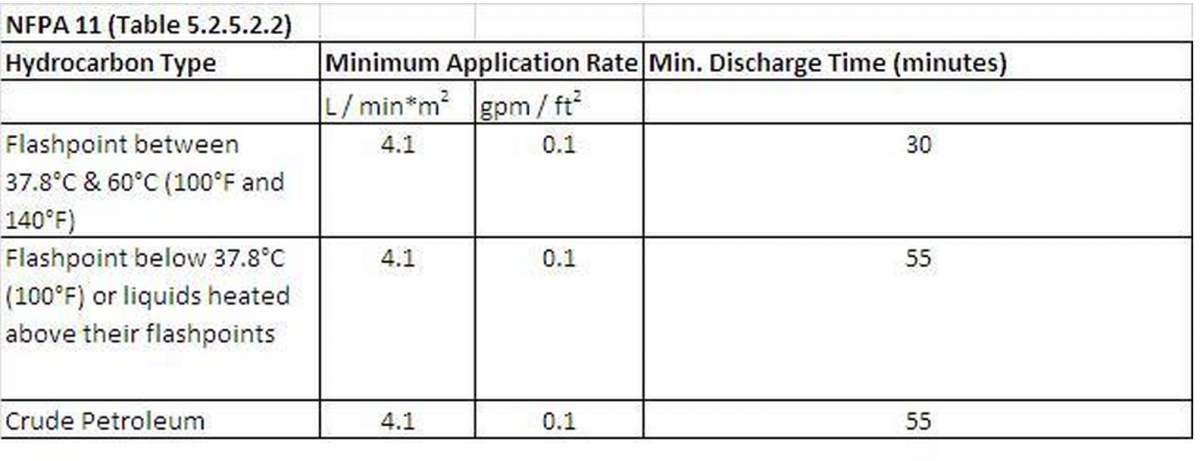
For sub-surface injection of foam-water solution in Fixed-roof (Cone) storage tanks NFPA 11 gives the following application rates and minimum discharge times:
 
Minimum Discharge Times & Application Rates for Type II Fixed Foam Discharge Outlets on Fixed-Roof (Cone) Storage Tanks Containing Hydrocarbons
 
NFPA 11 (Table 5.2.5.2.2)
 
Attached Image 

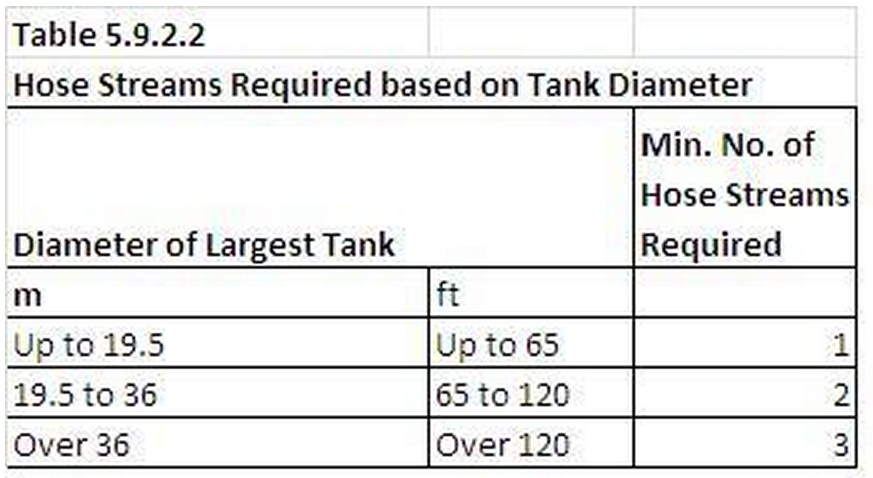
Besides the NFPA 11 standard related to sub-surface injection of foam in hydrocarbon storage tanks, NFPA 11 also provides recommendations for supplemental hose stream requirements for foam spraying. Following are the recommendations:
 
5.9.2.1: Approved foam hose stream equipment shall be provided in addition to tank foam installations as supplementary protection for small spill fires.
 
5.9.2.2: The minimum number of fixed or portable hose streams required shall be as specified in Table 5.9.2.2 and shall provide protection of the area.
 
NFPA 11 (Table 5.9.2.2)
 
Attached Image 
 
5.9.2.3:  The equipment for producing each foam stream shall have a solution application rate of at least 189 L/min (50 gpm), with the minimum number of hose streams shown in Table 5.9.2.2.
 
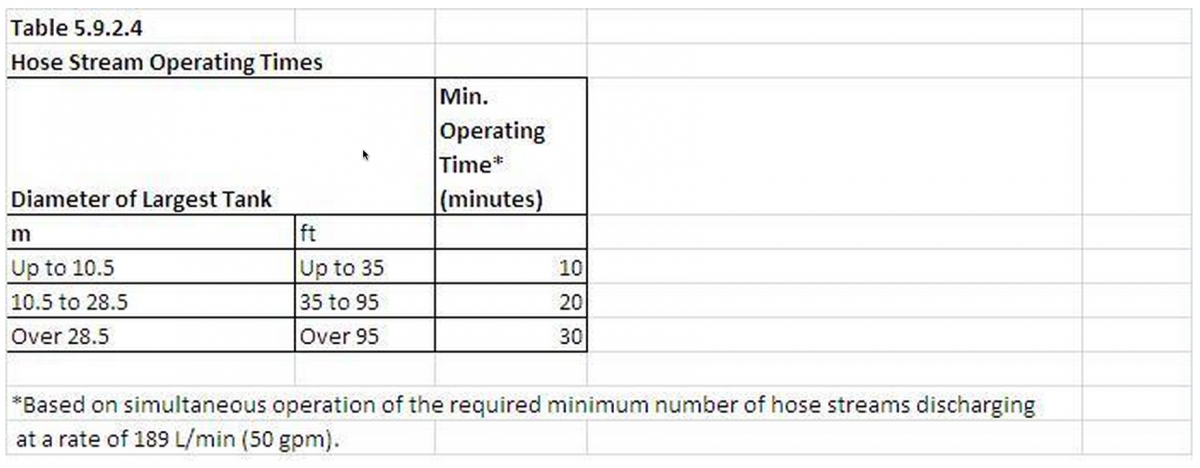
5.9.2.4: Additional foam-producing materials shall be provided to allow operation of the hose stream equipment simultaneously with tank foam installations as specified in Table 5.9.2.4.
 
NFPA 11 (Table 5.9.2.4)
 
Attached Image 
 
Let us do some actual calculations for finding out the foam requirement of some storage tanks:
 
Problem Statement:
 
Two Tanks storing Aviation Turbine Fuel (ATF) are provided in a common diked area. The capacity of each tank is 8895 m3. The tank dimensions are 30 m D X 12.2 m H. The containment dike for this pair of tanks is 65.5 m W X 104.5 m L. Calculate the foam-water solution requirement, 3% foam concentrate requirement & storage requirement for foam concentrate.
 
Solution
 
Inputs
 
No of Tanks: 2
Tank Diameter (each): 30.5 m
Tank Height (each): 12.2 m
Dike Width: 65.5 m
Dike Length: 104.5 m
Foam concentrate: 3%
Application Time for tanks: 30 minutes
Application Time for Dike: 20 minutes
Foam Concentrate Storage Buffer: 200%
 
Calculations
 
Tank C/S area: 730.6 m2
Gross Dike Area: 6845 m2
Net Dike Area: 5383.5 m2 (Gross Dike Area - 2*Tank C/S Area)
Foam Solution Rate for Tanks: 5991.1 LPM (4.1*Tank C/S Area*2)
Foam Soln Rate for Dike: 22072.4 LPM (4.1*Net Dike Area)
Foam concentrate Rate for tanks: 179.7 LPM (Foam Soln Rate for Tanks*3%)
Foam concentrate rate for Dike: 662.2 LPM (Foam Soln Rate for Dike*3%)
Foam concentrate qty reqd for tanks: 5392 Liters (Foam conc. rate for tanks*Application time for tank)
Foam concentrate qty reqd for Dike: 13243 Liters (Foam conc. rate for dike*Application time for Dike) 
Total Foam concentrate qty: 18635 Liters (5392 + 13243)
Foam concentrate storage capacity: 37270 Liters or 37.3 m3 (18635*Foam concentrate storage buffer)

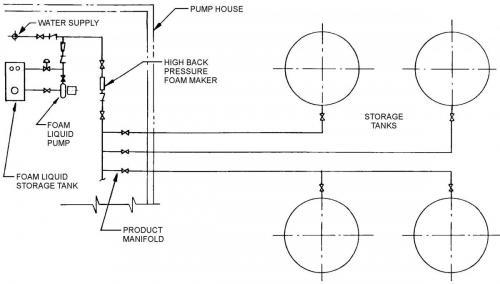
A process flow scheme for fixed sub-surface foam system is shown as an attachement to this blog entry.
 
Attached Image